Email marketing automation is one of the most effective ways to reach your customers at the right moment and AI has made it faster and more accessible than ever. Where you once needed a developer or data analyst to set up a complex trigger flow, today most platforms let marketers do it themselves. Tooling has caught up with ambition.
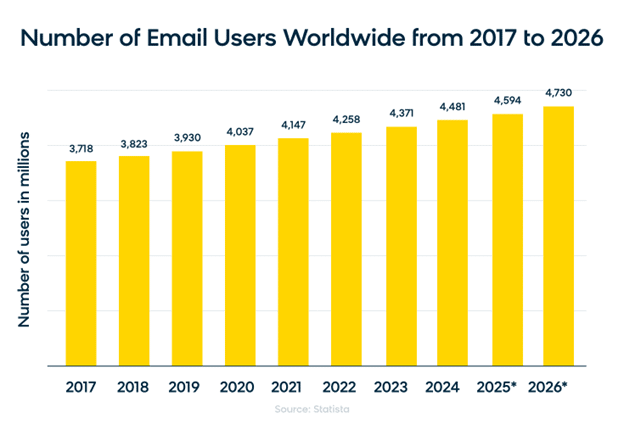
Email remains the king of digital marketing channels and for good reason. With 4.5 billion users worldwide, projected to reach 4.89 billion by 2027, it dwarfs every other channel, including Facebook, WhatsApp, and Instagram.
What does modern automation look like in practice? Instead of a monthly newsletter to your full list, you send a follow-up only to people who clicked on a specific product. Instead of a manual re-engagement campaign once a quarter, a workflow fires automatically after 45 days of silence. Instead of guessing what to recommend, your platform pulls from purchase history and does it for you.
This guide walks through the strategies other marketers in your field are using, the real-world examples behind them, and the practical steps to build your own approach, without the jargon.
8 Email automation strategies used by marketers like you
These eight campaign types come up again and again when you talk to email marketers, CRM specialists, and digital marketers who are getting consistent results. They are not exotic. They work because they connect the right message to a specific moment in the customer journey.
- Welcome Series When someone signs up, they are at peak interest. A three-part welcome series — sent over the first week — consistently outperforms a single welcome email. The first email confirms the signup and sets expectations. The second introduces your best-selling products or most useful content. The third responds to what they did (or did not do) with emails one and two.
- Abandoned Cart More than 70% of online shopping carts are abandoned. A three-step reminder flow — at 1 hour, 24 hours, and 1 week after abandonment — recovers a meaningful share of that. Including the specific product, a review or two, and a time-limited incentive in the final email tends to perform best.
- Browse Abandonment Someone looked at a product page but did not add to cart. An automated email 2 to 4 hours later, showing what they browsed alongside similar items, captures intent that would otherwise disappear.
- Re-engagement Subscribers who have gone quiet for 30, 60, or 90 days need a different approach than active customers. A short sequence with a clear value proposition — and an explicit option to unsubscribe — tends to either win them back or clean your list. Both outcomes are good.
- Post-Purchase Follow-up The relationship does not end at checkout. Order confirmation, shipping update, delivery notification, and a review request 7 to 14 days later form a simple sequence that builds trust and generates social proof you can use elsewhere.
- Birthday and Anniversary Emails A personal message with an exclusive discount on a customer’s birthday generates nearly three times the open rate of a standard campaign. These emails are easy to set up once and run indefinitely.
- VIP and Loyalty Programs Customers who hit a spending threshold get an invite to an exclusive tier: early access to sales, a dedicated contact, or members-only content. These workflows increase customer lifetime value by rewarding your best customers in ways that feel personal, not generic.
- Cross-sell and Upsell Sequences Seven to thirty days after a purchase, an automated email suggesting a complementary product or an upgrade performs significantly better than a cold promotional email. The purchase history tells you what to recommend — you just need the workflow to send it.
7 Real-World examples of email marketing automation
The strategies above are only useful if you can picture how other teams have actually put them to work. Here are seven concrete examples.
Welcome series with a conditional branch. An online retailer sends a two-part welcome. If the subscriber clicks through to a product category in email one, email two surfaces bestsellers from that category. If they do not click, email two sends a broader bestseller list instead. One workflow, two paths, much better relevance.
Abandoned cart with a hard deadline. A home goods brand sends three cart reminders. The third email — sent one week after abandonment — includes a 10% discount valid for 48 hours. That final email drives the majority of recovered revenue in the sequence.
Browse abandonment with social proof. A fashion retailer triggers an email after someone views a product without adding to cart. The email shows the viewed item, how many people bought it this week, and two similar options. Conversion rates on this campaign are consistently higher than on standard promotional emails.
Re-engagement with a clear choice. A subscription brand sends a three-email win-back sequence after 60 days of inactivity. The final email is blunt: “Do you still want to hear from us?” with two buttons — yes or no. The people who click yes become significantly more engaged in the months that follow.
Post-purchase review request. A beauty brand waits 10 days after delivery, then sends a short email asking for a review. The email includes a photo of the purchased product and takes the customer directly to the review form. Review volume increased by over 60% after automating this step.
Birthday email with a personal touch. A specialty food retailer sends a birthday email with a 15% discount and a message from the founder. Open rates on this email are nearly three times their list average. The discount redemption rate is twice that of standard promotions.
Cross-sell based on purchase history. A sports equipment retailer automatically sends a cross-sell email 14 days after purchase, recommending accessories that fit what the customer bought. The email is generated dynamically based on product category. It contributes around 18% more revenue per recipient compared to generic promotional emails.
How to build your own automation strategy
Starting with automation does not require a full platform overhaul. Most teams that do it well start small, prove value, and expand. Here is how.
Start with one clear goal. Are you trying to recover abandoned carts? Reduce churn? Improve post-purchase loyalty? Pick one. It will determine which campaign you build first and what success looks like.
Map out the trigger and the response. Every automation starts with a specific event: a signup, a purchase, a product view, 30 days of silence. Define that trigger, then define the one action you want the customer to take as a result. Keep it simple.
Write for one person, not a segment. The best automated emails feel like they were written for the individual reading them. Use the customer’s name, reference what they actually bought or viewed, and make the next step obvious.
Set up the workflow, then test it. Run the trigger yourself before it goes live. Check the email on mobile. Confirm the link goes to the right page. A/B test subject lines once you have enough volume. Small improvements compound quickly.
Review and adjust every quarter. Automation is not set-and-forget. Open rates shift, customer behavior changes, and offers that worked last year may not work today. Schedule a quarterly review of your top three flows.
What to look for in an email automation tool
Not all platforms are built the same. When evaluating tools, focus on what actually determines whether your campaigns succeed.
- Behavioral triggers that work in real time. If the platform can only segment by static attributes, you will always be behind the customer.
- Native connection to your customer and product data. The more your email tool knows about purchase history, browsing behavior, and lifecycle stage, the more relevant your automation can be.
- Visual workflow builder. You should be able to build and adjust flows without involving a developer for every change.
- A/B testing built into the automation layer. Not just for subject lines — for content, timing, and offers too.
- Reporting that connects email activity to revenue. Open rates matter, but what you really want to know is what the campaign is worth.
When customer data, product catalog, and automation live in the same environment, AI can do more than suggest a subject line: it can predict churn risk, personalize send times down to the individual, and surface recommendations grounded in real behavior.
The real opportunity isn’t AI that writes emails for you — it’s AI that thinks alongside you, across every touchpoint in the customer journey. Loomi is built for exactly that.
This is an article by EMAS 2026 Gold Sponsor Bloomreach.
Curious how to put this into practice? Visit EMAS 2026 on June 11 at Circa Amsterdam. Be inspired by international speakers and discover how to take your email marketing to the next level. Tickets and programme: emas.nu

Carl Bleich
Content Marketing Manager | Bloomreach
Ook interessant
Gezocht: Experts voor de Internationale E-mail Benchmark

Customer data strategies don’t fail, they just don’t deliver