
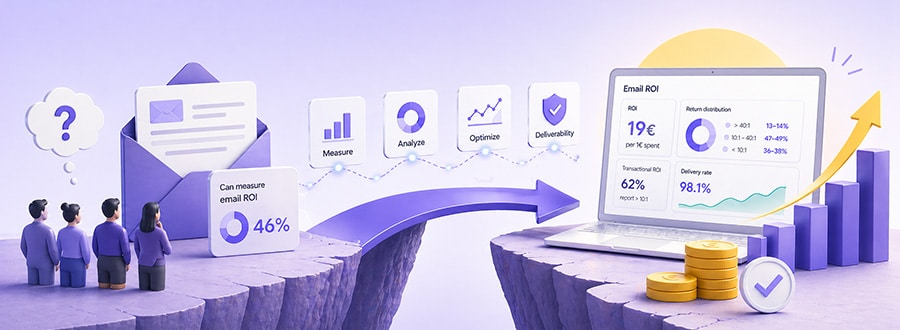
Email ROI is no longer in question, but measurement still is
At Sinch Mailjet, this tension is clearly reflected in the findings from the Sinch Mailgun Email Impact Report, based on a global survey of more than 1,200 email senders and real sending data from over 400 billion emails.
The data shows that fewer than half of senders can accurately measure the ROI of their promotional emails, despite consistently strong returns. This creates a growing problem: mailbox providers increasingly reward genuine user engagement. In other words, you cannot optimise deliverability without understanding performance, and you cannot understand performance without measuring it.
The organisations that move from “a channel we believe in” to “a channel with proven business impact” will be better positioned to justify budgets, defend programmes and systematically improve results.
What the numbers show
Let’s start with the good news. Among senders who do measure email ROI, the results are compelling:
- More than 60% report at least €10 return for every €1 invested
- Around 13–14% achieve returns above 40:1
- Transactional email delivers similarly strong results
Making 10 euros for every 1 euro invested in a communication channel is genuinely exceptional, and the majority of senders measuring their returns are already there.
Sinch Mailgun Email Impact Report
But those figures only cover senders who measure. Only 46% say they can measure the ROI of promotional email. For transactional email, that drops to 43%. The majority of professional email senders do not have a clear financial picture of what their email programme returns.
That is not a niche problem. When 23% of respondents cite difficulty proving email’s ROI as a top barrier to investment, and 20% struggle to get leadership buy-in, the root cause is almost always the same: the data is not there to make the case.
How to Tackle Email ROI: From belief to evidence
Closing the measurement gap does not require a complete operational overhaul. It starts with a few deliberate improvements in how email performance is tracked and reported.
Start with the right formula
The baseline calculation is straightforward. Take the total revenue attributed to email, subtract total email costs, divide by those costs, and multiply by 100. The result is your ROI percentage. A programme returning 200,000 euros against 10,000 euros in costs delivers a 1,900% ROI or roughly 19 euros per euro spent.
The challenge is making that calculation honest. Revenue attribution is rarely clean. Digital customer journeys involve multiple touchpoints, and email often contributes at more than one stage. If your organisation uses last-click attribution, email will be under-credited. If it uses first-click, the picture will be different again.
The most defensible model for email is time-decay attribution, which assigns greater weight to touchpoints closer to conversion. This reflects email’s tendency to appear throughout the customer journey without over-crediting any single interaction.
Account for what transactional email actually does
Transactional email: order confirmations, shipping updates, password resets and fraud alerts, does not drive revenue directly. But it protects it.
A failed password reset email blocks a user from completing a purchase. An undelivered payment reminder increases the risk of churn. A missing shipping update generates a support ticket. Each of these represents a measurable cost, and each avoided failure has a quantifiable value.
The numbers add faster than most teams expect. If just 1% of your 10,000 daily password reset emails fail to deliver, and that prevents 50 purchases at an average order value of €50, you are losing €2,500 every single day — from one message type, at a failure rate most organisations would consider acceptable. That is €75,000 a month quietly leaving through a door nobody is watching.
Organisations that want an honest view of transactional email ROI need to work across departments: support, finance, product. The data exists, but it rarely sits in one place. The effort is worth it. Among those who do measure transactional email ROI, 62% report returns above 10:1.
Move beyond open rates
Open and click rates remain useful engagement indicators, but they are not enough to demonstrate business impact.
Metrics such as:
• Revenue per email
• Revenue per campaign
• Total email-driven revenue
• Customer retention impact
provide a much stronger foundation for proving value internally.
At the same time, deliverability metrics such as bounce rates, inbox placement and spam complaints have become critical indicators of sender reputation and long-term performance.
Deliverability and engagement are now inseparable
Mailbox providers like Gmail, Yahoo and Outlook increasingly use engagement
There is a direct connection between measurement and deliverability that is easy to miss. Mailbox providers like Gmail, Yahoo, and Outlook use engagement signals to determine where emails land. If your programme is generating low opens, high bounces, or elevated spam complaints, your inbox placement will suffer, regardless of how technically sound your sending infrastructure is.
That means deliverability cannot be optimised in isolation. You need to understand which segments are engaging, which content drives action, and which lists are stale. All of that requires measurement. The programmes struggling most with deliverability are often those flying blind on performance.
Among the top performers in the benchmark data, the pattern is consistent. Air Freight and Logistics achieved a 99.25% delivery rate with a 0.01% bounce rate. Capital Markets recorded 98.13% delivery with low unsubscribe volumes. These are not just good infrastructure numbers. They reflect sender behavior: clean lists, relevant content, engaged audiences.
Where email investment is heading in 2026
The forward-looking signals in the report point to a channel that is not only stable but attracting renewed investment, particularly from organisations willing to treat email as a discipline rather than a default.
Budgets remain strong
31% of organisations plan to increase their email budgets in 2026, while only 7% expect reductions. The remaining 48% plan to maintain current investment. Taken together, that means roughly 79% of organizations are treating email as a stable or growing line item.
That is a meaningful signal. In a period when marketing budgets are under scrutiny, email is holding its ground and then some. The 78% of respondents who describe email as very or extremely important to organizational success are not speaking in abstractions. They are describing a channel that, when it fails, is felt immediately across the business.
AI is accelerating email performance
AI adoption in email marketing is rapidly increasing:
• 79% of senders already use or plan to use AI
• The most common applications include copy generation and subject line optimisation
• More advanced use cases include predictive analytics, segmentation and send-time optimisation
Importantly, organisations already using AI report significantly stronger programme performance compared to those that are not.
54% of senders who have implemented AI say their email programmes improved moderately or significantly in 2025, compared to 37% among those not yet using AI.
AI is not a shortcut to success. But it is becoming a major accelerator for teams with strong foundations in measurement and deliverability.
Authentication standards are becoming essential
The technical environment around email is tightening, and that is broadly good news for senders who have their house in order.
DMARC adoption has risen from 43% in 2023 to 61% today, driven partly by enforcement requirements from Google, Yahoo, and Microsoft. More than half of those using DMARC have now moved to quarantine or reject policies, meaning they are actively blocking emails that fail authentication rather than simply monitoring the situation.
BIMI adoption has jumped from under 10% in previous years to 22% of all senders. Seventy-six percent of BIMI users report tangible benefits after launching inbox logos, including higher open rates and improved brand recall. For European senders operating across multiple markets, these signals matter: inbox trust is increasingly earned through authentication, not assumed.
The accountability gap is the next frontier
The data from the Email Impact Report makes one thing clear: email’s performance is not the problem. The problem is the gap between what email delivers and what organisations can document, defend, and build on.
Senders who close that gap — by investing in measurement, attribution, deliverability monitoring, and authentication — are the ones who will be able to act on what AI, automation and securing real deliverability by high engagement make possible. They will also be the ones with the evidence to protect and grow their email programmes when budgets come under pressure.
The 2026 shift in email is not primarily a technology shift. It is an accountability shift. The channel has always performed. Now it needs to be able to prove it.
Email does not need to prove it can deliver results — it already has. What it needs now is the measurement infrastructure to prove it every single time, to every stakeholder who controls the budget.
This is an article by EMAS 2026 Gold Sponsor Sinch.
Curious how to put this into practice? Visit EMAS 2026 on June 11 at Circa Amsterdam. Be inspired by international speakers and discover how to take your email marketing to the next level. Tickets and programme: emas.nu

David Jordine
Senior Technical Account Manager at Sinch Mailjet
Ook interessant
Gezocht: Experts voor de Internationale E-mail Benchmark

Customer data strategies don’t fail, they just don’t deliver