Full Funnel Marketing - Zo laat je branding en performance succesvol hand in hand gaan
De marketingwereld ziet er compleet anders uit dan tien jaar geleden. Naast branding is het belang van performance enorm toegenomen en het aantal kanalen is flink gegroeid. Dit zorgt voor verschillende uitdagingen. Hoe zet je de klant echt centraal in je marketingstrategie? Hoe zet je online kanalen succesvol in voor branding? Hoe sluit branding op een goede manier aan op de performance-activiteiten? De full funnel marketing-methode vormt het antwoord op deze vragen.
In dit artikel leggen de leden van de DDMA Commissie Digital Marketing Transformation uit wat full funnel marketing inhoudt en lichten zij een KPI-framework dat je praktisch kunt toepassen uit. Ook vind je in dit artikel do’s en dont’s én een succesvol praktijkvoorbeeld. Het artikel is ook verschenen op Emerce.
Van one-size-fits-all naar relevantie
De afgelopen jaren heeft er een shift plaatsgevonden van ‘one-size-fits-all’-achtige push-marketing naar een meer gesegmenteerde en gerichte aanpak. Consumenten zitten niet meer te wachten om advertenties te zien van een product of dienst van een bedrijf waar ze geen gebruik van zullen maken of niet mee geassocieerd willen worden. Sterker nog, het zorgt voor een negatieve merkassociatie met bedrijven die dit wel nog op deze agressieve manier aanpakken.
Capabele marketeers begrijpen dat het belangrijk is om product in de markt te zetten op een specifieke en relevante manier en duidelijk te maken waarom dit zo goed past in het leven van hun doelgroep. Het begrijpen van de mogelijke ‘customer journeys’ die een potentiële klant af kan leggen van bewustzijn naar aankoop is hiervoor een vereiste. Deze verschilt per persoon en per product of dienst. Zo ziet het aankoopproces van een keuken er heel anders uit dan het aankoopproces van een t-shirt.
Full funnel marketing
Nadat een potentiële klant het idee krijgt dat hij mogelijk je product zou willen aanschaffen, heeft hij vaak tijd nodig om zich te oriënteren. Als je jouw marketingstrategie benadert vanuit klantperspectief, dan realiseer je je dat een klant vaak niet direct een actie onderneemt zonder dit oriëntatieproces. Je marketingstrategie moet hier goed op aansluiten. Hoe zorg je ervoor dat een potentiële klant van jouw bedrijf afweet, zich oriënteert en uiteindelijk de aankoop bij jou doet?
Het antwoord is full funnel marketing. Een strategie waarbij je in elke fase van de journey relevant bent als bedrijf en hier ook de juiste kanalen en middelen inzet om je doelgroep te bereiken. Een wereld waarbij de communicatieafdeling een branding-campagne bedenkt en de online marketeers onafhankelijk een performance-campagne optuigen is dus verleden tijd. Het één gaat niet zonder het ander.
Om per fase van de customer journey te bepalen welke middelen en welke communicatieboodschap je gebruikt, zijn er een aantal gangbare modellen die je kunt gebruiken. Van de meer traditionele modellen zoals Touch, Tell, Sell tot moderne modellen als See, Think, Do, Care.
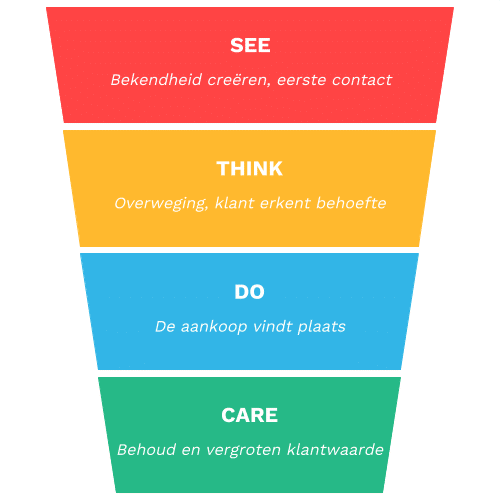
Dergelijke modellen dwingen marketeers om na te denken vanuit de klant. De vraag die centraal dient te staan is ‘Aan welke boodschap heeft mijn (potentiële) klant behoefte in deze specifieke fase van de customer journey en hoe zorg ik ervoor dat mijn boodschap in alle fases op elkaar aansluit?’ Dit laatste onderdeel is vaak onderschat, maar een logische opvolging in communicatieberichten is cruciaal voor het succes van een full funnel marketing-strategie.
KPI-framework voor full funnel marketing
Maar hoe weet je of je boodschap de juiste is en hoe optimaliseer je hierop? Wanneer je puur optimaliseert op performance dan zijn je KPI’s vaak duidelijk. Wanneer je optimaliseert op basis van de customer journey dan zijn er meer KPI’s waar je rekening mee moet houden. Essentieel hiervoor is een KPI-framework. Met een KPI-framework ben je in staat om per fase van de customer journey te bepalen voor welke metrics je optimaliseert en of je marketing inzet succesvol is geweest. Hieronder vind je een voorbeeld van een KPI-framework.
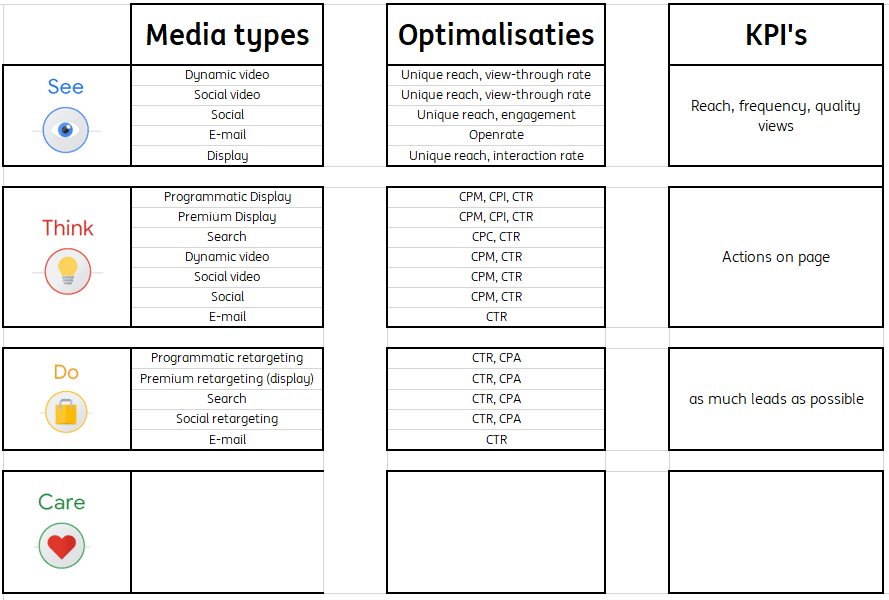
In het KPI-framework staat de belangrijkste KPI geformuleerd – in dit voorbeeld zijn dat leads – maar ook KPI’s die hier direct en indirect aan bijdragen. Elke fase in het model heeft zijn eigen KPI’s waarop gestuurd wordt. Marketing inzet in de See-fase wordt in dit geval bijvoorbeeld niet direct afgerekend op leads, maar wel op hoe er indirect aan wordt bijgedragen. De Care-fase is in dit voorbeeld niet meegenomen.
Do’s en don’ts voor full funnel marketing
Leuk, die theorie, maar hoe realiseer je nou daadwerkelijk een succesvolle full funnel marketingstrategie? Een aantal praktische tips:
Do’s
- Stel per fase (per KPI) een meetbaar target op. Begin vanuit je hoofddoelstelling en reken vervolgens terug wat dit betekent voor de doelstellingen van de fases hoger in de funnel. Zo kun je bijvoorbeeld je salesdoelstelling terugrekenen naar traffic en views.
- Speel in op de behoefte van de (potentiële) klant, afhankelijk van de fase waarin hij of zij zit en stem de content en boodschap hierop af.
- Zorg dat de boodschappen en uitingen voor de verschillende fases goed op elkaar aansluiten
- Hou bij het bepalen van de maximale CPA (Cost Per Acquistion, in de Do-fase) rekening met de initiatieven binnen de campagne die niet direct op sales worden afgerekend (maar wel kosten met zich meebrengen)
Don’ts
- Zorg dat plannen voor full funnel-campagnes niet per fase door verschillende teams worden uitgewerkt
- Focus je bij grootschalige performance-campagnes niet alleen op kanalen die direct converteren. Zonder de juiste aandacht voor upper- en midfunnel-initiatieven zul je waarschijnlijk je hoofddoelstelling niet halen.
- Denk niet dat al je (potentiële) klanten lineair door alle fases van de customer journey lopen, zoals jij het van tevoren bedacht hebt. Hou hier rekening mee in de boodschap in mid- en lowerfunnel-uitingen.
Full funnel marketing in de praktijk
Case: NS – Treinpakkers
De Treinpakkers-campagne van NS bestaat uit voordelige uitjes in combinatie met een treinticket, zoals musea, stedentrips, beurzen, dierentuinen en pretparken. Binnen deze grootschalige campagne worden verschillende marketingdoelstellingen nagestreefd, zoals het vergroten van de bekendheid van deze producten, het creëren van overweging voor het gebruik ervan en (uiteindelijk) de aankoop van de producten. Daarbij werden voorheen al wel verschillende uitingen en kanalen ingezet voor de verschillende marketingdoelstellingen, maar deze initiatieven sloten vaak niet goed op elkaar aan.
In de nieuwe full funnel marketing-aanpak is ervoor gezorgd dat dit veel meer op elkaar is afgestemd. Zo zijn er bijvoorbeeld in de See-fase dynamische video’s ingezet met algemene informatie over Treinpakkers. Consumenten die deze video hebben uitgekeken, kregen vervolgens enkele dagen later video’s en banners te zien met informatie over specifieke Treinpakkers-deals (Think-fase). Degenen die deze video’s uitkeken of klikten op de banners werden vervolgens geretarget met meer salesgerichte banners over een specifiek product (Do-fase).
Dit heeft onder meer geresulteerd in een significante stijging van Treinpakkers-aankopen en daling van de CPA van de ads die ingezet werden, vergeleken met eerdere campagnes die op een meer traditionele manier werden ingezet.
Hoe nu verder
Met het bovengenoemde framework, de do’s & dont’s en de voorbeeldcase kun je aan de slag met full funnel marketing. Ons advies: gewoon beginnen. Start klein en ga vervolgens aan de hand van inzichten langzaam campagnes uitbouwen, budgetten anders verdelen en je interne stakeholders meenemen. Dit zorgt voor een hogere ROI uit je marketinguitgaven, intern voor een goede teamspirit en natuurlijk meer relevantie richting jouw doelgroep. Want dat is wat je uiteindelijk wil bereiken: de klant altijd in de juiste context én op het juiste moment raken.
Op donderdag 5 maart organiseert de commissie Digital Marketing Transformation een Afternoon Update over de impact van marketplaces. Er zijn nog maar een paar plekken beschikbaar!

DDMA Non Profit member Meetup – Wat gebeurt er als je mensen vraagt om mee te doen in plaats van doneren? – Community building met KiKa
Bij KiKa staat het verbinden van mensen rond één gezamenlijke missie centraal: 100% genezing van kinderkanker. Dat betekent niet alleen fondsen werven, maar mensen actief betrekken bij het doel. Van families en actievoerders tot onderzoekers, vrijwilligers en partners, iedereen maakt onderdeel uit van een groter geheel.
Jakolien deelt hoe KiKa community building structureel heeft verankerd in strategie, organisatie en communicatie. Wat vraagt het van leiderschap? Hoe zorg je dat mensen zich niet alleen aansluiten, maar zich écht verbonden voelen? En hoe vertaal je betrokkenheid naar langdurige impact?
Met haar achtergrond in communicatie, fondsenwerving en topsport combineert Jakolien focus, teamgevoel en doorzettingsvermogen in haar aanpak. Ze laat zien hoe sterke communities niet alleen bijdragen aan fondsenwerving, maar aan merkwaarde, loyaliteit en toekomstbestendigheid.
Wat kun je verwachten?
- Inzichten in hoe community building strategisch wordt ingezet bij KiKa
- Praktische voorbeelden van het activeren en verbinden van verschillende doelgroepen
- Inspiratie om community-denken toe te passen binnen je eigen organisatie
Voor wie?
Voor marketeers, fondsenwervers en communicatieprofessionals die verder willen kijken dan campagnes en willen bouwen aan duurzame relaties.
Mocht je onverhoopt niet aanwezig kunnen zijn, dan vragen we je om dit zo snel mogelijk te laten weten aan info@ddma.nl We hanteren een no-show fee van €50,00 als we niet op de hoogte zijn van je afwezigheid, of als je je last-minute afmeldt (24 uur van tevoren).
Meld je aan voor dit evenement met jouw DDMA-account
Dit event is uitsluitend bij te wonen door DDMA-leden. Leden kunnen zich aanmelden via hun persoonlijke DDMA-login.
- Ben je lid en wil je inloggen? Klik op onderstaande gele login knop. Het aanmeldformulier wordt na het inloggen vooraf ingevuld met je gegevens die al in jouw account staan geregistreerd.
- Ben je lid maar heb je nog geen account? Vraag dan hier jouw DDMA-account aan.
- Ben je nog geen lid en wil je meer informatie over het lidmaatschap? Lees hier meer over het lidmaatschap.
Praktische informatie
2 juni @ 03:29
Gratis voor DDMA leden
Deel dit evenement
GDMA International Email Benchmark 2026 toont verschuiving in verzendstrategie
De Nederlandse Acceptance Rate (99,3% AR) en Click to Open Rate (11,7% CTO) bleven in 2025 vrijwel gelijk aan vorig jaar. Tegelijkertijd herstelde de Unique Open Rate (OR) met 2,5 procentpunt tot 48,9%, terug op het niveau van 2023. Ook de Click Through Rate (CTR) steeg licht naar 6,2%.
Wereldwijd stabiliseren de resultaten eveneens. De AR bleef met 98,6% stabiel, terwijl de OR (34,2%) terugkeerde naar het niveau van 2023. De CTO (7,7%) en CTR (3%) laten licht herstel zien. Consumenten lijken commerciële e-mails weer vaker te openen en na ontvangst ook iets vaker door te klikken, waarbij inhoud en relevantie bepalend blijven voor engagement.
Van eindejaarspiek naar always-on e-mailstrategie
De benchmark wijst uit dat e-mailcampagnes steeds meer ‘over het jaar’ worden verspreid. Waar Q4 in eerdere jaren duidelijke piekmaanden waren door Black Friday- en eindejaarscampagnes, was het verzendvolume in 2025 gelijkmatiger verdeeld.
Wereldwijd loopt de verzendpiek inmiddels vanaf juli en neemt het aandeel campagnes richting november en december iets af. In Nederland blijft de periode vanaf 1 oktober een belangrijke, maar ook hier verschuift de mailstrategie naar een meer jaarronde aanpak.
Door campagnes meer te spreiden proberen organisaties minder afhankelijk te zijn van piekmomenten en op meer momenten relevant aanwezig te zijn in de inbox van consumenten.


Meer spreiding over verzenddagen
Ook in de keuze voor verzenddagen is een verandering merkbaar. Wereldwijd worden campagnes vaker op dinsdag én donderdag verstuurd, waar donderdag eerder de belangrijkste verzenddag was. Bovendien neemt het aandeel ‘campagnes’ in het weekend toe.
Nederlandse marketeers zijn hierin terughoudender. Hoewel dinsdag de afgelopen jaren populairder is geworden, blijft donderdag de belangrijkste verzenddag.
Ook is in Nederland een verschuiving zichtbaar in verzendtijdstippen. In 2025 werden de meeste campagnes verstuurd tussen 10.00 en 12.00 uur, terwijl verzendingen voorheen vaker verspreid waren over de vroege ochtend (7.00–9.00 uur) en vroege avond (19.00 uur).
“Bij DDMA menen we dat succesvolle e-mailmarketing niet draait om zoveel mogelijk zenden, maar om relevante contactmomenten en duurzame klantrelaties. De benchmark illustreert dat organisaties steeds meer zoeken naar manieren om gedurende het hele jaar relevant en zichtbaar te zijn voor consumenten,” aldus Judith Oude Sogtoen, directeur bij DDMA.
Over de GDMA International Email Benchmark 2026
De GDMA International Email Benchmark 2026 is gebaseerd op geanonimiseerde campagnedata uit de periode 2021 t/m 2025. Voor deze editie leverden 15 E-mail Service Providers data aan: Doppler, emBlue, Flexmail, Hellodialog, ICOMM mkt, Maestra, MailBlaze, Maileon, Mailkit, Marigold, SAP/Emarsys, Selzy, Spotler (waaronder Tripolis), Ternair en TouchBase Pro. In totaal vertegenwoordigt de benchmark data van 22 ESP’s over meerdere edities.
De 2026 update omvat data van 17,7 miljoen e-mailcampagnes (ten opzichte van 11,4 miljoen in de editie van 2025) en 847 miljard verzonden e-mails (tegenover 521 miljard vorige editie). De benchmark specificeert 61 landen verspreid over Europa, Noord-Amerika, Centraal-Amerika en Zuid-Amerika, APAC, Afrika en het Midden-Oosten.
De GDMA International E-mail Benchmark is een onafhankelijk initiatief van DDMA en de Global Data & Marketing Alliance (GDMA). Meer weten over het onderzoek of deelnemen aan een volgende editie? Neem contact op met Robin de Wouters (GDMA) via rdewouters@fedma.org of Nanda Appelman (DDMA) via nandaappelman@ddma.nl.
Ook interessant
GDMA International Email Benchmark 2026 toont verschuiving in verzendstrategie
The great email Reset: Unpopular tips to improve your email marketing and change how you think about email
Navigating the future of email marketing: Embracing AI and deliverability challenges
The great email Reset: Unpopular tips to improve your email marketing and change how you think about email

“We’ve all been taught the wrong fundamentals when it comes to email,” says O’Malley. Turns out Beth is not here to politely polish old assumptions. She wants a reset.
Beth O’Malley will be presenting at the DDMA Email Marketing Automation Summit 11 June with her session called “The Email Reset: Strategy, Behaviour, and Performance in 2026″
Ahead of her session, she sat down with email marketing consultant Jordie van Rijn to talk about inbox psychology, broken email foundations, deliverability, AI, intent-based marketing, and why brands need to stop treating email like a machine and start treating it like human communication.
The great email reset
Your talk is called the great email reset. What is it that needs resetting? And why do we need it now?
Beth: What the Great Email Reset is really about is resetting how we think about email, expectations, objectives and of course, resetting what we think success actually looks like.
Because I think we’ve all been taught the wrong fundamentals when it comes to email. A lot of the current email philosophy is heavily shaped by e-commerce and performance marketing.
We’ve been taught that email means ROI. That it is a revenue-generating channel, so optimise opens and clicks, capturing attention. And we’ve been taught “best practices” that are heavily outdated and some just incorrect.
How we use our inboxes is different from what marketers think.
Beth continues: “The inbox is utility-driven. In our personal lives we use email because we have to. It’s where order confirmations go, travel details, insurance documents, conversations about buying houses, important documents, important information.
And then in our professional lives, it becomes even more task-oriented. No matter how many tools businesses introduce like Slack or Teams, email is still the primary communication tool for work for most people. So psychologically, people enter the inbox differently.
You enter it with purpose, you enter it to complete tasks, you enter it to process information.
Not to endlessly browse. It’s always one thing: to check.
And when you understand that, you start to realise that inbox behaviour is completely different to social or site behaviour. Even down to how people scan information, look at the design, make decisions, and how their eyes move across the screen.
Contrast that to how we use social media. Social media is passive; it’s entertainment, it’s browsing and it fills our brains with dopamine hits.”
Most email best practice ignores the way that we use the inbox
We’ve become obsessed with whether one email got slightly more opens, instead of looking at email as a relationship-building channel over time. Because really, email should be nurturing, supporting, informing, and helping somebody move through a journey with you.
Are we delivering value consistently?
Are we building trust?
Are we helping somebody?
Are we creating a return on relationship rather than just chasing short-term performance?
That’s what The Great Email Reset is really about.
It’s resetting how we think about email, resetting expectations, resetting what success actually looks like and resetting your objectives.
How does AI influence the need for looking differently at Email?
I think we need a reset now more than ever because AI and automation are accelerating everything.
We’re constantly being told to do more with less, generate more results, move faster and automate more. Plug this tool into this tool, and suddenly your email performance magically improves. But in a lot of ways, we’re just accelerating bad habits, approaches and expectations.
So for me, the reset is actually really simple. If we fundamentally understand what the inbox is for, how human beings behave inside it, and how people naturally process communication, email becomes significantly more effective.
And ironically, when you stop treating email like a machine and start treating it more like human communication, the commercial results usually improve too.
Email market trends and how to ignore them
What can email marketers learn from trends they see? We know you are a bit weary of just following what others are doing. So, what is your beef with trends?
The thing that I don’t believe in with email, first of all, is trends. You can’t have an email trend. There are no such thing as trends in the inbox.
And I’ll give you probably one of the best examples of this, which is the Mother’s Day and Father’s Day opt-out campaigns. Ultimately, this became a trend. One brand did something, everybody praised it, thought it was amazing, really emotive, really thoughtful, and then every other brand jumped on it.
So what started as one thoughtful campaign turned into every single brand doing the exact same thing. And what we started seeing in the UK, was consumers receiving huge numbers of these emails. And the original intention gets completely lost.
Because if somebody has lost their mum, and they receive 20 or 30 emails asking if they want to opt out of Mother’s Day campaigns, it stops feeling thoughtful. It stops feeling kind. It actually becomes emotionally exhausting because you are repeatedly forcing somebody to revisit the same emotional trigger over and over again.
And this is one of the biggest problems in email, everybody thinks their audience only sees their email. People think if they make their email clever enough or emotional enough or good enough, people will ignore everything else in the inbox. But that’s not how the inbox works.
Your email doesn’t live in isolation. The complete media and inbox consumption including what people are receiving from other brands and companies shape how they experience your email. And in turn, how they engage with you.
The idea of trends in email is flawed because you can’t control what else your audience is receiving around you. This is another massive reason why we need this reset.
How about copying or “getting very heavily inspired” by examples from others?
We’ve created this culture of copying. People go onto email inspiration galleries, “really good email” sites, award sites, LinkedIn posts, and everybody is trying to copy what somebody else has done because they think, well, it worked for them so it must work for us.
But like everything in marketing, it depends. It depends on your audience, your relationship with them, your goals, your brand, your timing, your positioning, your trust levels, all of it.
And with email specifically, copy-and-paste marketing just doesn’t work in the way people think it does because everybody ends up sounding and looking the same.
The other side of this is deliverability, and this is another reason we desperately need a reset, because spam filters and inbox providers are finally catching up with brands that have spent years just blasting emails to entire databases without really understanding strategy, audience behaviour, or even the laws around the inbox itself.
The other big thing is volume. Since COVID especially, email volume has massively increased and I don’t think we’ve really recovered from that. Everybody is sending more, more campaigns, more automations, more nurture journeys, more sales emails, more newsletters, more AI-generated content.
A lot of businesses got very comfortable just sending everything to everyone, following a calendar, pushing volume, repeating campaigns, and now they’re suddenly finding that what they used to get away with doesn’t work anymore because inbox providers are becoming stricter to protect the user experience.
And I always say there are laws of the inbox; deliverability is absolutely one of them. Inside that you’ve got reputation, engagement, list quality, trust, consistency, authentication, audience behaviour, all of these different things that now matter more than ever.
So for me, the reason we need the reset comes down to all of this combined, we’ve got trend culture, copy-and-paste marketing, rising email volume, AI accelerating content creation, worsening inbox experiences, and stricter deliverability systems, but underneath all of that is still the same issue: brands are forgetting they are communicating with human beings inside a shared environment.
Shattering the email glass ceiling for better results
You talk about the email glass ceiling. What do marketers need to catch up on?
What I see constantly with marketers is what I call the email glass ceiling. It’s like Maslow’s hierarchy of needs, you can’t do the next layer until you’ve properly optimised the layer underneath it. It is more of an inverted pyramid, but the principle is the same.
And at the bottom of that hierarchy sits your three pillars of email:
* your systems,
* your strategy, and
* your data.
I’ve trained thousands of marketers across the world, I work with marketing teams every single year, and one of the biggest frustrations I see is marketers being expected to generate better and better results whilst working within broken foundations.
They’re expected to build automations, improve revenue, use AI, personalise journeys, increase engagement, but one or more of their three pillars is either broken, messy, outdated, disconnected, or just fundamentally not fit for purpose.
And that creates an email glass ceiling. There comes a point when no matter how talented the marketer is, they physically cannot get better results because the foundations underneath them are limiting what’s possible.
So if your systems are not integrated properly, there’s your first glass ceiling. If your CRM and your email platform are disconnected, your data is already out of date the second you export and import it. You are constantly working reactively instead of strategically.
If your data is messy, incomplete, badly structured, or you’re not collecting the right information, data quality and list hygiene is another glass ceiling because you cannot do proper intent-based marketing, segmentation, automation, or personalisation without good data.
And if your strategy is weak, if email is just “send a newsletter every Tuesday because that’s what we’ve always done”, there’s another part of the glass ceiling.
How is this different from 2 or 3 years ago?
So I think one of the biggest differences now versus even two years ago is that marketers need to become much more aware of what is realistically possible within the environment they are working in.
What are the expectations being placed on them?
What are the actual capabilities of their systems, strategy, and data?
What sits inside their circle of control?
And what actually requires business-wide transformation to achieve?
Because I think marketers have been carrying a huge amount of pressure to produce better results from environments that fundamentally aren’t designed for modern email marketing.
Jordie adds: “If you look at it from a zoomed out marketing perspective, the email marketing and life cycle role is, in cases, marginalised to only mean Promotion.
But you can’t see separately from Product, Price, Place, and all those other Ps and Cs that influence the outcome. Remember Michael Porter, remember 4 to 7Ps of Marketing, and I even think Mark Ritson is correct in saying Product is what you want to influence.
So we should take back the discussion into the sphere of influence, where you can adjust things: Adjust propositions, segments, make your own landing pages, change pricing and discount offers, go arrange partnerships to grow your list.
Revolt, Revolution, Relevancy! (ok sorry about the mini-rant, but this may need a reset of its own :P) “
The second thing is deliverability.
Beth brings up the second issue: If somebody came into email marketing today and ignored deliverability, they would already be behind. Because even if your strategy never changes, even if you’re just a business sending a newsletter every Tuesday from a content calendar, understanding deliverability alone could dramatically improve your results.
If more of your emails reach the inbox, that is already a win.
You don’t necessarily need to completely reinvent your strategy overnight. Sometimes the biggest issue is simply that a significant percentage of your audience is not even seeing your emails because they are landing in spam, promotions, junk folders, or being filtered entirely.
And the problem is most marketers have never properly been taught deliverability.
It’s become one of the biggest areas I specialise in because there’s very little education out there that properly teaches marketers how to understand it, monitor it, audit it, track it, or know what to actually do when there’s a problem.
Most people stop at, “we think we’re going into spam.”
Okay, but why?
What caused it?
What signals are inbox providers seeing?
What behaviour is damaging your reputation?
What does healthy engagement actually look like?
How do you recover from it?
There’s a huge gap there.
Human behaviour in the inbox
You mentioned the behavior in the inbox before is a reason for the reset, let’s zoom in on that a bit. What is
Understanding human behaviour in the inbox is a marketers’ job. Because when I talk about inbox psychology, most people instantly relate to it personally. Everybody suddenly goes, “yeah actually, I barely click marketing emails myself.”
It’s always a minority of people who actively open, click, engage, and convert from email. That’s normal human behaviour. So when you understand inbox psychology properly, you stop chasing impossible expectations and you start approaching email differently.
You can become more creative, more strategic, more thoughtful, because you stop treating every single campaign like it has to “win” immediately.
Ironically, when marketers lower some of those unrealistic expectations and start understanding how people naturally behave inside the inbox, they usually end up getting much better results anyway.
Young talent and personal growth for marketers
We have an award at the Email Summit that goes into Young talent and often winning cases are driven by individual people (and their teams). What would a marketer need to get the label “Queen of CRM” like you?
I think the first thing is to fail repeatedly and be really open to changing your own beliefs and mindset. Where I am today is very, very different to where I was five years ago and even the things I used to teach or talk about five years ago. My thinking has evolved massively through experience, through projects, through things not working, through being wrong.
And I think one of the biggest misconceptions people have is that experts somehow know everything or never fail, and that’s just not true.
I fail all the time!
I would never sit here and say, give me any business and I can absolutely guarantee I’ll transform their email marketing overnight because everything depends. Every business is different, every audience is different, every system is different, every challenge is different.
I still make mistakes. I still sometimes get things wrong. I still test things that don’t work.
But I actually think being wrong teaches you the most important lessons.
A huge amount of what I know now has come from failure, from pressure, from troubleshooting, from projects going sideways, from having to figure things out in real time.
And I think being self-employed accelerated that learning massively for me because I work across so many different businesses, industries, systems, teams, and problems all at once. You see patterns really quickly, you learn really quickly, and you develop this ability to connect dots across completely different environments.
So I think the first thing is being willing to fail and evolve your thinking instead of becoming too attached to your own opinions.
Being confident is a huge win for marketers.
The second thing is confidence. And I don’t mean arrogance, I mean genuinely believing in yourself and your knowledge enough to put your voice out there.
Because no one is going to magically turn around one day and crown you “the queen of CRM”. If anything, the title itself is a bit cringey and a bit tongue-in-cheek, but I knew very early on that if I wanted to educate people, help people, and genuinely change parts of the industry, I needed to stand for something.
I needed people to remember me, see my point of view, and have confidence in my own voice. Because if you don’t believe in yourself, nobody else is going to believe in you either.
And I think the other really important thing is having an opinion and being willing to say something different.
Not for the sake of being controversial, but because you genuinely believe it.
Everything I teach, every framework I’ve built, every piece of education I put out there comes from years of experience, testing, failing, observing patterns, and understanding what fundamentally works in the real world.
And I think people connect with that because it’s coming from experience, not theory.
So for me, becoming really good at CRM, email, strategy, any of it, comes from a combination of failure, curiosity, confidence, experience, and being brave enough to challenge things that you don’t think are right anymore.
Jordie adds: “This is such an important part. I’d say confidence isn’t a state of mind, but a reflection of confident actions and what you say. In a relaxed way. Confident people are the most relaxed people in the room. If you at least act confident, mindset will follow over time.
Put yourself in an environment that stimulates growth and initiative. Help shape that environment for yourself – every day again. Not throwing things “over the fence”. It may just be the key to unlock a bonus-tier and wind at your back for everything that you as a marketer do. An all star marketeer, if you have the chops, reputation works for you, just like a top athlete for instance.
It is good to keep in mind: Brand management wants you to take initiative and to succeed, or if you are external, your contact wants their agency and freelancer to go the extra mile. And if you can’t lay your creative eggs in work, start a side quest and your own newsletter, personal brand on social.
To make it practical: Often marketers tend to get in a discussion about details and get a lot of feedback, that just drags out the process. And often where it isn’t needed.
For example I often remind myself and use these three:
“If we both have opinions on what works best, let’s go with my opinion, because that is what you hired me for.” and
“Design like you are absolutely right, then test like you were wrong from the start.”
“You can have a look if you want, but I am not asking you to review it”
What are some “assumptions / best practices” that aren’t really best practices in your eyes anymore?
Beth: I think the overarching thing with best practice is that every single marketer I meet just wants to know they’re doing things the “right” way.
And I completely get that because as humans, we don’t like getting things wrong. We don’t like the idea that there’s potentially a better way of doing something and we’re not doing it yet.
So a lot of the time when marketers go to webinars or events or training, they’re in part just looking for validation. They want someone to tell them, yes, that’s right, yes, you’re doing the right thing, yes, that’s best practice.
And the question I get constantly is, “what should we be doing?” Like, what should we be doing that we’re not doing already? What’s the right thing? What’s the best practice?
And underneath that is usually fear. Fear of getting it wrong, fear that another brand is doing something better, fear that there’s some secret formula everybody else knows about.
But I actually think the businesses that become the most successful are usually the ones that embrace getting things wrong because they understand that’s actually how you learn what works.
And I think one of the biggest assumptions in email is this idea that if we follow all the best practices, we’ll automatically get results. Marketing unfortunately doesn’t work like that.
And I know that because I used to be that marketer. I remember being in-house and genuinely thinking that if I just learned all the frameworks, followed all the advice, implemented all the best practices properly, then of course it would work.
But everything in marketing depends.
It depends on your audience, your positioning, your timing, your strategy, your relationship with your audience, your brand, your skills, your systems, all of it.
One of the biggest problems is that the industry takes practices and labels them as universal truths.
And I think once marketers stop obsessing over getting everything “perfect” and instead focus more on understanding people, testing properly, learning from failure, and understanding their own audience, they usually become much better marketers.
Jordie adds: “It helps to think of your strategy as a start-egy instead. You start with the plan you trust has a solid chance to succeed, put together considering the environment and restrictions. But the strategy isn’t the main part of the success, it is the starting and doing. The plan should change over time anyway (and it will).”
Beth: Yes, and for instance in tactics, a really good example is, your call-to-action should always be above the fold.
Again, that’s not a best practice, that’s a technique. It might work brilliantly in one email and terribly in another depending on the audience, the message, the intent, the design, the device, the context, all sorts of different things.
So I think marketers need to stop looking for universal rules in email because there really aren’t many.
Most things in email are practices, techniques, approaches, guiding principles, things that need to be adapted to your audience and environment.
How does a marketer go and make sure they are serving their audience, rather than doing hacks that work?
Beth: It’s quite rare that I look at an email and think, wow, that tactic was genius.
For me, the smartest email marketers are very rarely the ones doing flashy things or clever hacks or weird growth tactics. The smartest ones are usually the ones that deeply, deeply understand their audience.
And I think there’s a really big difference there.
I definitely see marketers who already know exactly what they want to do strategically, but they’re restricted by tools, systems, budget, internal sign-off, data quality, all those kinds of things. A lot of marketers are actually far smarter than the environments they’re working in allow them to be.
One campaign that always sticks in my mind was an abandoned basket journey.
What impressed me wasn’t the design or the copy or some crazy tactic, it was the way she understood the psychology behind why people abandon baskets in the first place.
Because most abandoned basket emails are really assumptive. They basically go, “hey, you forgot this” or “you left this behind.”
But most people didn’t “forget”, most people deliberately leave things in baskets. An abandoned basket is usually an open question. It’s uncertainty. It’s hesitation. It’s somebody thinking, “I’m not sure yet.”
So instead of treating abandoned basket like a reminder campaign, she treated it like a trust-building and objection-handling campaign.
The whole journey was built around answering questions, reducing uncertainty, building confidence, reinforcing value, adding trust signals, helping people make a decision.
She understood that maybe the person thought it was too expensive, maybe they didn’t fully understand the value yet, maybe they were comparing alternatives, maybe they just weren’t emotionally ready to buy at that moment.
And because she understood the audience psychology so well, the performance was incredible. A really great e-commerce marketer I worked with did this, I think the abandoned basket journey had something like an 87% conversion rate. It was genuinely one of the best-performing journeys I’ve ever seen.
But again, it wasn’t because of some magical tactic.
It was because she understood people. And I think that’s probably the biggest compliment I can give any marketer. When I receive an email and I genuinely feel like somebody understood me, understood where I was at, understood what I needed at that exact moment, that’s when I’m impressed.
Those are the emails that get a little round of applause from me, and usually a reply as well, because I actually like marketers knowing when they’ve done a really good job
What about the tools and software?
Beth: The first thing I always say when people ask me about tools is that the tool is very, very rarely actually the problem.
People constantly ask me things like, what’s the best email service provider, what platform should we move to, what tool should we be using, and my answer is usually… none of them, or all of them, because fundamentally most email service providers now all do very similar things.
They all have automations, segmentation, reporting, templates, AI features, all of that stuff.
So for me, the tool itself is rarely the thing holding people back.
What actually matters is your three pillars, your systems, your strategy, and your data, and I’d actually say data is probably the biggest one there because the real power of tools comes when you have integrated data and a proper source of truth across the business. That’s when tools become more useful.
So for me it’s always data over tools.
In terms of features and new things coming out, there honestly isn’t really a feature where I’ve looked at it and gone, wow, that completely changes everything.
I think the things that are interesting are anything that helps marketers understand people better, analyse behaviour better, identify patterns faster, anything around predictive analysis, intent signals, things that help marketers process information quicker, those are useful.
Anything that speeds up operational tasks is useful as well, like helping build emails faster or helping structure things faster, but I don’t think any of it replaces the audience brief or the strategy layer.
Jordie adds: “I help companies select email marketing software for over 10 years – and guide dozens of RFPs and selection questions. More than anyone out there. My experience tells a picture – where I agree with Beth that foundations are… foundations so you have to get that right.
But the right Marketing can really make the difference between success and frustration.
It is the same point as Beth makes, but a layer on top. I have seen so many teams be frustrated by the tooling that was over-promissing, inherited, or it is a great tool, but not the best fit for the team and job they wanted to do. A hammer is great for hammering, not so much for baking a cake. Making the wrong decision can set you back a year, year and a half – you may even fail the implementation and need to start over.
To give you a simple example that explains it all:
In a selection I guided, there was a team that had to manage international versions of each mailing. In the tool they had that was terrible. Another could do it, but still would take about 20 hrs a week. Another (they didn’t know about, but we ended up selecting) they brought that international email process back to 2 or 3 hours a week. That makes all the difference.”
Everybody is looking at AI – what are your thoughts on that?
Beth continues: I’ve seen loads online around AI agents that can supposedly run your entire email programme for you, build campaigns for you, write everything for you, optimise everything for you, and are we there yet? No. We’re absolutely not there yet.
And I’ve always said this, if you already don’t understand email strategy, inbox psychology, audience behaviour, all the philosophy stuff I talk about, AI just allows you to produce more bad content faster.
You might get slightly more output, you might even get slightly better results because you’re producing more volume, but fundamentally it doesn’t solve the underlying issue.
And I also think people massively underestimate how much time they spend trying to fix AI outputs.
I’ve literally watched people spend half an hour rewriting prompts, tweaking wording, correcting tone, trying to make something sound human, changing bits over and over again, and at some point you have to ask yourself, is this actually saving time?
Or are you trying to use AI to replace a skill gap that still fundamentally needs human thinking behind it?
AI is not magically fixing poor strategy.
The AI tools I genuinely use and would struggle without now are mostly around data analysis, pattern recognition, helping process large amounts of information quickly, helping identify trends or gaps faster, that’s where I think AI is genuinely very powerful right now.
But when it comes to replacing human understanding, audience psychology, strategic thinking, relationship building, understanding nuance, emotion, timing, context, I just don’t think we’re there yet.
Jordie adds: “Generative AI really already heightened the bar, and changed what interesting content has to look like in 2026. Think about what you can do with images, video, writing and coding. The development in those areas is phenomenal. Marketers feel the mix of excitement mixed with tears and fear for the future.
And there is no way to keep up with the latest (shiny) things in all areas. The worst thing to do is put your head in the sand and pretend this isn’t happening, second-worst is to believe all the hype and mass delusion. AI email writing tools, for instance, have gotten verrrryyy good. Already general models like ChatGPT and Claude are so good, if you know how to use them. You can choose to use AI tools or use handwritten and a mix. Just make sure you do it for the right reasons.”
Practical tips to improve email performance
Beth concludes with some practical tips:
I think the first thing, as I’ve said already, is deliverability, because if your emails are landing in spam, that’s your biggest issue right now.
The more people that actually see your emails, especially the right people, your warmest audience, your highest intent audience, the people most likely to engage with you, that alone can massively improve performance without changing loads of other things.
The other big practical strategy for me is intent-based email marketing, and I really don’t think this is spoken about enough.
And actually, I don’t really believe in personalisation anymore, at least not in the way it’s been pushed out into the industry for years, where personalisation basically became putting someone’s first name in a subject line or dynamically changing a product block.
I’m much more interested in intent.
Because intent tells you where somebody is psychologically.
Intent-based email marketing is really about understanding what somebody has shown you or told you through their behaviour. That could be warm intent, cold intent, hot intent, but your hot intent is the most important because that’s where somebody is actively trying to solve a problem or make a decision.
And I think marketers need to become much better at creating intent buckets.
So instead of just blasting campaigns to everyone, you’re asking yourself, okay, what has this person shown me, what have they told me, what behaviour have they demonstrated that means I now need to send this message at this exact moment?
Because your audience is constantly giving you signals.
That could be form submissions, website visits, webinar attendance, pricing page views, content downloads, product browsing, all sorts of things.
And this is where I always recommend doing a TFDS exercise, thinking, feeling, doing, saying.
If somebody is showing intent, what are they thinking? What are they feeling? What are they doing? What are they saying? And you map everything out.
Are they uncertain?
Are they comparing options?
Are they Googling solutions?
Are they talking about this internally?
Have they written it on a to-do list?
What objections do they have?
What unanswered questions do they have?
Because that then can become your content strategy.
So for example, from a B2B perspective, if somebody downloads a lead magnet around email deliverability, then visits my certification programme pages multiple times, then starts reading all my deliverability blogs, especially the more problem-focused ones, I already know that person likely has a deliverability issue they’re trying to solve.
That’s intent.
So I’m going to activate that person differently because they’ve shown me where they are psychologically and commercially.
Or from a B2C perspective, let’s say somebody completes a hair quiz on a haircare website, browses loads of products afterwards, spends time looking around, then leaves the site.
Most brands immediately jump to discounts or promo codes.
But actually, that person probably has uncertainty. They probably have unanswered questions. They’re not fully convinced yet. They’re still evaluating.
And because they completed the quiz, they’ve already given you loads of information about themselves that you can now use intelligently.
So instead of sending generic abandoned browse emails, you create an intent-based journey around the likely uncertainty they’re experiencing.
And for me, intent-based email marketing will almost always outperform generic campaigns because it’s based on what somebody has actively shown you or told you.
So one of the biggest practical things marketers can do immediately is go and look at everything they already track.
What are people filling in on forms?
What behaviour are they showing?
What signals are they giving you?
What intent can you identify?
And then start grouping people into intent buckets.
The other thing I’d say is marketers need to get much better at understanding what metrics actually matter and understanding the impact email has outside of opens and clicks because opens and clicks only tell you a very small part of the story.
A lot of the things I talk about around intent, inbox psychology, relationship-building, deliverability, all of that stuff, I write about a lot anyway, so honestly the best thing I’d recommend is just going through my blog because everything I teach is built around these principles and practical application rather than generic email advice.
Beth O’Malley is the Founder of astral, an unstoppable CRM and email marketing expert (and an ADHDer with a great sense of humour).
She’s trained thousands of marketers, developed industry-shaping guidelines, practices and training. Plus, she’s helped businesses generate £10M+ in assisted revenue from her expertise in just 18 months.
She’s been awarded best Full-Service CRM & Email Agency 2024, Top International Women Entrepreneurs, and a recognised HubSpot Partner. Beth helps businesses reimagine, rethink and transform CRM, data, and email marketing. You can connect with her on Linkedin and read her blog “the Vault”
This article was written by Jordie van Rijn independent email marketing consultant and founder of Email Vendor Selection.
Ook interessant
GDMA International Email Benchmark 2026 toont verschuiving in verzendstrategie
The great email Reset: Unpopular tips to improve your email marketing and change how you think about email
Navigating the future of email marketing: Embracing AI and deliverability challenges
Een toekomstbestendig cookie-kader: kan de Omnibus dat waarmaken?
Wij roepen (nationale) beleidsmakers daarom op om de gevolgen van voorgestelde vereenvoudigingen in de Digital Omnibus zorgvuldig en integraal te beoordelen. Wij onderschrijven het belang van sterke privacybescherming en transparante gegevensverwerking. Tegelijkertijd is het essentieel dat nieuwe regelgeving voldoende rekening houdt met technische haalbaarheid, proportionaliteit en de werking van het digitale ecosysteem. In dit stuk leggen we uit waarom het Omnibusvoorstel rond cookies, zowel praktisch als juridisch, geen oplossing biedt voor consumenten en bedrijven in de marketingsector.
In het kort: wat verandert er?
Het voorstel koppelt de regels rondom cookies sterker aan de systematiek van de AVG en introduceert uitzonderingen op het vragen van toestemming, bijvoorbeeld voor beveiliging, fraudepreventie en bepaalde vormen van eigen metingen.
Daarnaast introduceert het voorstel zogeheten ‘privacy signals’: browser- of apparaatinstellingen waarmee gebruikers per apparaat vooraf kunnen aangeven niet gevolgd te willen worden.
Versimpeling?
Hoewel dit op het eerste gezicht eenvoudiger lijkt, roept het voorstel belangrijke juridische, technische en economische vragen op. De context waarin persoonsgegevens worden verwerkt verschilt namelijk per website, dienst en toepassing. Een algemene browserinstelling kan die context moeilijk meenemen, terwijl de AVG juist vereist dat toestemming voldoende specifiek en geïnformeerd is.
Daarmee dreigt een systeem te ontstaan waarin gebruikers in de praktijk vooral kunnen kiezen tussen volledig accepteren of volledig blokkeren. Dat beperkt niet alleen de nuance in gebruikerskeuzes, maar kan ook grote gevolgen hebben voor de financiering van digitale diensten en het functioneren van het open internet.
Vooral kleinere Europese ondernemingen, publishers en digitale dienstverleners lopen het risico onevenredig geraakt te worden. Grote internationale platforms beschikken over omvangrijke hoeveelheden first-party data en gesloten ecosystemen, terwijl kleinere partijen afhankelijker zijn van onafhankelijke advertentie-, meet- en analysetechnieken om hun diensten effectief aan te bieden en te financieren. Het risico bestaat dat de voorgestelde vereenvoudiging uiteindelijk juist leidt tot meer markconcentratie en minder ruimte voor innovatie en concurrentie.
Daarnaast bestaat zonder verdere harmonisatie het risico op uiteenlopende interpretaties en implementaties binnen de EU, waardoor de juridische en technische complexiteit voor organisaties juist verder toeneemt.
Conclusie
Wij zien daarom behoefte aan een coherenter en meer risicogebaseerd regelgevend kader, waarin onderscheid wordt gemaakt tussen verwerkingen met een hoog privacyrisico en toepassingen met een beperkt risico en een aantoonbaar consumenten- of veiligheidsbelang. Alleen zo ontstaat regelgeving die zowel gebruikers beschermt als innovatie en concurrentiekracht ondersteunt. Voor meer toelichting, verwijzen we hiervoor naar de Position Paper van FEDMA.
Wij pleiten daarom voor toekomstbestendige digitale regelgeving die transparantie, gebruikerscontrole en eerlijke concurrentie versterkt, zonder innovatieve digitale dienstverlening onnodig te beperken. Privacy gaat over het maken van geïnformeerde keuzes. Dat vraagt niet per definitie om minder datagebruik, maar om verantwoord, transparant en ethisch omgaan met persoonsgegevens. Een toekomstbestendige digitale economie bouw je op vertrouwen. Dat vertrouwen ontstaat wanneer gebruikers begrijpelijke en genuanceerde keuzes krijgen, niet wanneer complexe afwegingen vooraf worden teruggebracht tot een algemene aan- of uitknop.
Meer weten over cookies en Digital Omnibus? Vraag gratis advies aan onze DDMA legal cousels via legal@ddma.nl.
Ook interessant
Een toekomstbestendig cookie-kader: kan de Omnibus dat waarmaken?
Versterking DDMA Legal team
AI-labeling: wat marketeers moeten weten over transparantie voor AI
Alleen met een schoon kanaal zorgen we dat fieldmarketing blijft bestaan

“Het kanaal heeft alleen toekomst als we er met elkaar voor zorgen dat het professioneel, transparant en betrouwbaar blijft.”
Ritter houdt zich bij KPN dagelijks bezig met de strategische en operationele kant van fieldmarketing. Binnen de DDMA-commissie richt hij zich vooral op wetgeving, zelfregulering en kennisdeling binnen de sector.
“Voor mij was dat ook de belangrijkste reden om bij de commissie aan te sluiten”, vertelt hij. “Ik wilde dicht bij het vuur zitten. Niet alleen om kennis vanuit mijn eigen expertise te delen, maar ook om actief mee te denken over de toekomst van het vak.”
Een sector onder een vergrootglas
Die toekomst wordt momenteel voor een groot deel bepaald in Den Haag. Binnen KPN maakt Ritter deel uit van een team dat zich bezighoudt met de mogelijke nieuwe regelgeving rondom fieldmarketing.
“Er lopen verschillende trajecten rondom wetgeving. Dat maakt dit voor de sector waarschijnlijk de meest urgente uitdaging van dit moment.”
Volgens hem is het bijzonder dat bedrijven binnen de branche gezamenlijk proberen op te trekken richting beleidsmakers. “We proberen actief mee te denken en branchebrede oplossingen aan te dragen die ook in de praktijk werkbaar zijn.”
Daarbij speelt praktijkkennis een belangrijke rol. “Binnen die projectgroep ben ik degene die vanuit het vakgebied concreet kan aangeven wat wel en niet werkt. Juist die praktijkvoorbeelden helpen om wetgeving realistischer en uitvoerbaar te maken.”
Toch had hij gehoopt dat de sector in sommige fases nog nadrukkelijker betrokken zou worden. “Door actief mee te denken verwacht je soms ook meer betrokkenheid in het verdere proces.”
Meer dan het stereotype
Volgens Ritter wordt fieldmarketing nog te vaak beoordeeld op basis van oude stereotypen.
“De negativiteit rondom colportage zorgt ervoor dat veel mensen heel eenzijdig naar het kanaal kijken. Alsof het alleen maar draait om gladde verkopers aan de deur.”
Dat beeld doet volgens hem geen recht aan de werkelijkheid. “Fieldmarketing is veel breder dan dat. Het biedt werkgelegenheid, direct klantcontact en helpt consumenten om bewuster naar hun abonnementen en contracten te kijken.”
Juist dat laatste aspect wordt volgens hem structureel onderschat. Veel consumenten kijken nauwelijks actief naar lopende contracten of bestaande diensten.
“Door mensen letterlijk even stil te laten staan bij hun huidige situatie, ontstaat vaak een breder perspectief. In veel gevallen zijn consumenten uiteindelijk goedkoper uit of krijgen ze een contract dat beter bij hen past.”
Kwaliteit moet zichtbaar zijn
De sector kan het zich volgens Ritter niet permitteren om achterover te leunen. Zeker nu politiek en maatschappij kritischer kijken naar direct sales-kanalen.
Daarom hamert hij op kwaliteit en controle binnen organisaties. “De Code Fieldmarketing moet voor iedereen die op straat loopt helder zijn én goed nageleefd worden. Dat moet echt geborgd zijn.”
Volgens hem ligt daar ook een duidelijke verantwoordelijkheid voor opdrachtgevers en bureaus. “Je moet inzicht hebben in wat wervers aan de deur doen en daar actief op sturen. Niet alleen op resultaten, maar juist ook op kwaliteit achter de schermen.”
Want uiteindelijk bepaalt de zwakste schakel het beeld van de hele sector. “We dienen er met z’n allen voor te zorgen dat we een zo schoon mogelijk kanaal bestieren. Alleen daarmee kunnen we ervoor zorgen dat fieldmarketing blijft bestaan.”
AI als kwaliteitsversneller
Naast regelgeving ziet Ritter nog een ontwikkeling die het vak de komende jaren sterk gaat veranderen: AI.
“De hele AI-evolutie zal steeds meer binnen fieldmarketing worden geïmplementeerd”, verwacht hij. “Vooral op het gebied van datastromen en kwaliteitsverbetering.”
Volgens hem kan technologie helpen om processen professioneler en consistenter te maken. “Dat gaat uiteindelijk leiden tot een kwalitatiever fieldmarketinglandschap, waarbij excessen steeds verder worden uitgesloten.”
Tegelijkertijd denkt hij niet dat technologie het menselijke aspect verdringt. Integendeel. Juist persoonlijk klantcontact blijft volgens hem de onderscheidende factor van het kanaal.
En buiten het werk? Dan is Ritter vooral te vinden thuis met zijn gezin, op de padelbaan of ergens in een voetbalstadion.
Ook interessant
Alleen met een schoon kanaal zorgen we dat fieldmarketing blijft bestaan
Je mag mensen iets vragen, maar je moet ook kunnen verdragen dat het antwoord nee is
Nieuwe gezichten in de DDMA Commissies Field Marketing en Post
Herschrijving Code Telemarketing van start

Die herziening draait niet alleen om het verwerken van nieuwe wet- en regelgeving. De ambitie ligt nadrukkelijk breder want de code moet beter aansluiten op de huidige praktijk, technologische ontwikkelingen én veranderende maatschappelijke verwachtingen rondom telefonisch klantcontact. De huidige Code Telemarketing 2024 en de bestaande Gedragscode Telemarketing vormen daarbij het vertrekpunt.
De afgelopen maanden heeft de commissie geïnventariseerd welke onderdelen verduidelijking of aanscherping vragen. Daarbij wordt onder meer gekeken naar onderwerpen als contactdruk, transparantie richting consumenten, gesprekskwaliteit, klachtenafhandeling en de rol van intermediairs en buitenlandse callcenters.
De eerste voorstellen zijn inmiddels verzameld, maar bevinden zich nadrukkelijk nog in de consultatiefase. De branche wordt daarom actief uitgenodigd om mee te denken. Het doel is om met een breed draagvlak te komen tot een sterker, professioneler en toekomstbestendig fundament onder telemarketing.
Consument centraal
Bij de herziening wordt nadrukkelijk rekening gehouden met de kaders van de Stichting Reclame Code (SRC). Dat betekent dat bepalingen binnen de code altijd direct betrekking moeten hebben op reclame-uitingen en consumentenbescherming.
“Uiteindelijk gaat het om de consument die we bellen”, benadrukt de commissie. “Die moet kunnen rekenen op duidelijk, zorgvuldig en betrouwbaar telefonisch contact.”
Onderwerpen die uitsluitend betrekking hebben op interne bedrijfsvoering vallen daarom buiten de reikwijdte van de Reclame Code. Waar relevant worden die onderdelen opgenomen in de aparte Gedragscode Telemarketing.
Brede samenwerking binnen de sector
Voor de herziening werkt de commissie samen met een brede groep organisaties uit de sector. Naast commissieleden nemen ook andere marktpartijen deel aan de schrijfgroep.
Aan het traject nemen onder meer deel: Postcode Lottery Group, Nederlandse Loterij, Essent, KPN, Longfonds, DMCC, 2Contact, Greenpeace, Fonky, Greenchoice, Goede Doelen Nederland en KSF.
De schrijfgroep komt de komende maanden meerdere keren bijeen om voorstellen verder inhoudelijk uit te werken. Uiteindelijk wordt de vernieuwde Code Telemarketing ter goedkeuring voorgelegd aan de leden van DDMA en vervolgens ingebed binnen de Stichting Reclame Code.
Met die herziening wil de sector niet alleen zorgen voor duidelijke regels voor de branche, maar vooral bijdragen aan beter, betrouwbaarder en waardevoller telefonisch contact voor consumenten.
Ook interessant
Herschrijving Code Telemarketing van start
Je mag mensen iets vragen, maar je moet ook kunnen verdragen dat het antwoord nee is
Oproep: schrijf jij mee aan de Code Telemarketing?
Ook interessant
De herroepingsknop komt eraan: wat verandert er voor jouw website?
Podcast Shaping the Future: De Pizzaiolo van New York Pizza